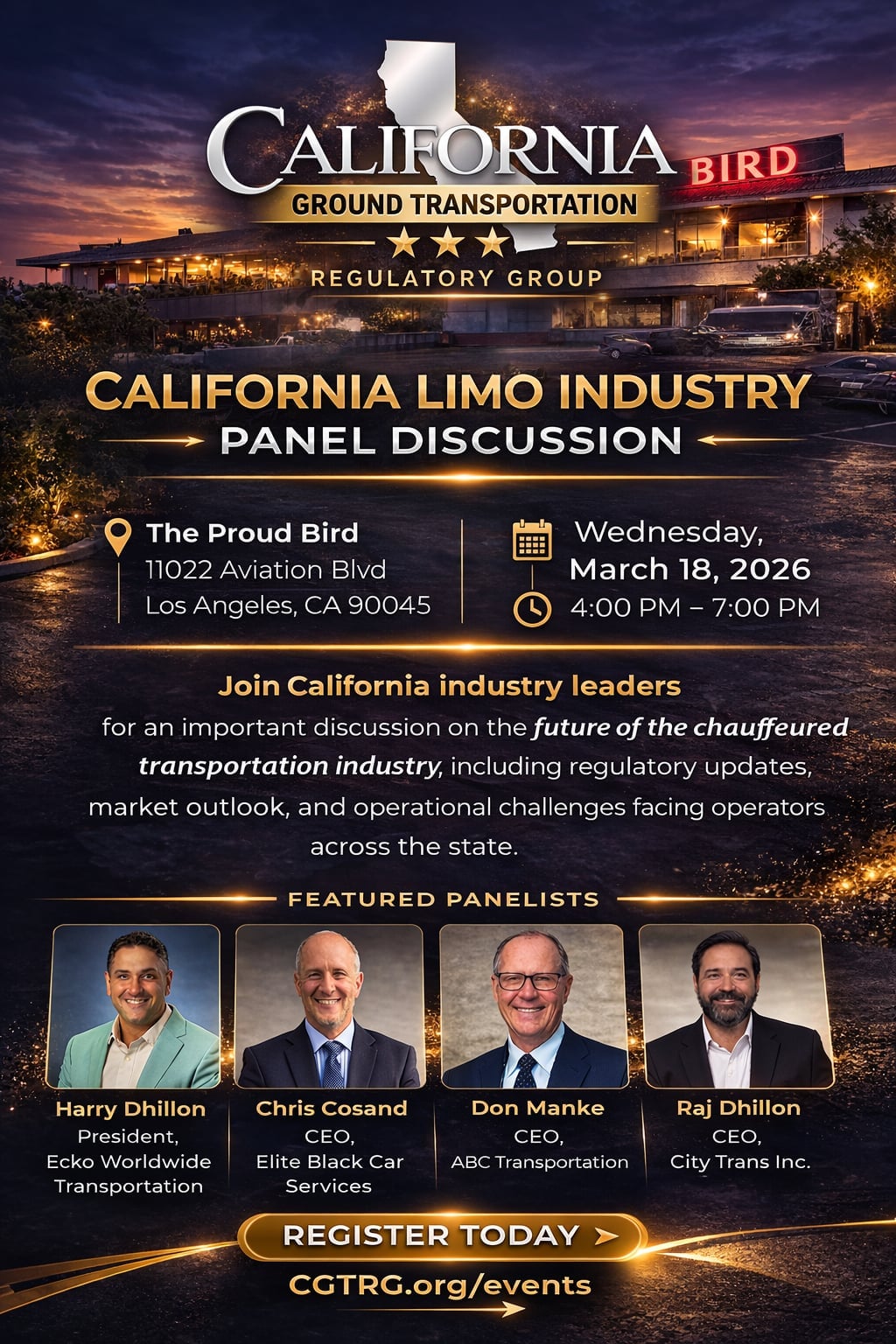
These are my notes from the California Ground Transportation Regulatory Group Event I attended on March 18th. There were 4 panelists and a moderator, Mark Stewart. The panelists were Harry Dhillon President, Ecko Worldwide Transportation; Chris Cosand CEO, Elite Black Car Services; Don Manke CEO, ABC Transportation; and Raj Dhillon CEO, City Trans Inc.
Panelists discussed how the definition of luxury is changing and what they are doing to keep up. They also discussed how they are keeping up with constantly changing technology without losing the human touch or sacrificing service quality. Additionally, they shared the challenges they face and their strategies for adaptation. Below, I have shared the questions and key points from the operators:
- Luxury definition question
The definition of luxury is changing… From your perspective as operators, how has the definition of luxury service changed over the past few years? And what are you doing differently today to meet those expectations?
- Luxury is a full package, not just the car
- It starts with the booking and conversation, continues through the chauffeur experience, and ends with billing and accounting.
- A luxury car helps, but the whole process being seamless and problem‑free is what feels like luxury.
- Frontline people are the core of luxury
- Clean vehicles, well‑trained, personable chauffeurs, and competent reservation/accounting staff define luxury.
- Service quality across all touchpoints is what keeps customers coming back.
- Service differentiates you when cars are similar
- Everyone can have similar vehicles; what separates operators is ease and quality of booking, riding, and billing.
- A slightly older but impeccably run service can beat a brand‑new luxury SUV with poor service.
- Removing client stress and being 100% reliable is now a key luxury element
- If the operator takes transportation stress off the client’s plate consistently, that’s perceived as luxury, especially for newer generations of clients.
- Technology vs human touch
“Technology is rapidly changing our industry… How do operators embrace new technology while still preserving the personal service and human touch that our industry is known for?”
Technology is a support tool, not the service itself
- Used for accounting accuracy, dispatching, alerts/notifications, driver info to passengers, etc.
- Core luxury still comes from chauffeur quality and training; if forced to choose, they’d invest more in chauffeur training than tech.
- Tech has dramatically improved operations over time
- Evolution from Nextel radios to modern systems, cameras in cars, better dispatch, and better communication with travelers.
- Tech makes operators more efficient and enhances service, but human touch remains central.
- Technology fails; humans fix it
- Tech is “great until it’s not”; human staff must step in when systems glitch.
- Operators are concerned about large software “roll‑ups” reducing choice but hope to gain useful new capabilities.
- Customer service around flights still needs people
- AI/customer‑service tech won’t fully replace human reassurance for flight delays, early arrivals, and airport pickups.
- Passengers like tracking and one‑button driver calls, but they also want a human in the loop.
- Biggest challenge in 2026
“From your perspective, what is the single biggest challenge facing transportation operators in 2026 and how are you adapting your business to address it?
- Labor and wages
- Labor availability and employee expectations are a major challenge, especially in California.
- Employees want higher wages and more benefits due to high cost of living.
- Insurance costs
- Insurance is “astronomical,” eating into profits.
- Combined with compliance and other costs, operating is becoming much more expensive.
- Competitive pressure from large platforms (Uber, Blacklane, etc.)
- These platforms run aggressive pricing and incentive programs, making it hard to maintain market share and pricing.
- Response: focus on human touch, training, and exceptional service to justify premium positioning.
- Post‑COVID cost increases across the board
- After COVID, vehicle costs, repairs, insurance, and chauffeur compensation all rose.
- Operators—especially small ones—must “tighten the belt,” cut costs smartly, and stay profitable regardless of fleet size.
- Affiliate cost control
- There is a need to closely monitor affiliate rates worldwide, as passing on sharply higher charges can drive customers away.
- Adaptation strategies
- Focus on profitability discipline, cost control, sharing ideas in associations, and being open‑minded to operational changes.
4.Sustainability and green fleets
“As operators look towards the future, how are you balancing the move toward greener fleets while still delivering the premium experience clients expect, and are you even pursuing that direction?”
- Strong skepticism about EV readiness
- Concern about charging reliability (e.g., a chauffeur needing to start at 4 a.m. and finding no charge).
- Many available EVs are not true luxury vehicles suitable for their clientele.
- Operators do not plan to go electric soon.
- Interest in self‑driving tech as a concept, but not for immediate fleet transition
- Some see value in future self‑driving cars to address labor issues and potentially run driverless operations.
- However, there is very little current client demand for “battery cars.”
- Operational risks with EV repairs and parts
- Stories of EVs sitting in shops for months waiting for parts after accidents.
- Insurance and repair timelines make EV adoption risky for small/medium fleets.
- Long‑term expectation of some EV/autonomous presence
- One speaker believes the government will keep pushing incentives and behavior change towards EVs and autonomous vehicles.
- Even with that, luxury operators expect to anchor on human touch and premium service while selectively considering green options later.
- Most impactful recent business decision
“What is one business decision you made in the last two years that significantly improved your operation?
- Compliance and chauffeur training (Harry)
- Invested more in compliance and training, especially as CDL vehicle volume increased.
- Focus on structured training and compliance has added clear value.
- Formalizing training programs and cost reduction (Raj)
- Introduced regular chauffeur training (CDL and non‑CDL) shortly before COVID.
- Re‑engineered business processes and moved some office work outside the country to reduce costs.
- Rebuilding post‑COVID and restoring benefits (Don)
- After being “annihilated” by COVID, focused on survival, rehiring staff, and reinstating benefits.
- Fleet is now about half its pre‑COVID size, but moving in the right direction.
- Adding 24/7 live agent support (Chris)
- Implemented 24/7 live agent phone support about three years ago.
- Believes this has significantly improved repeat business, reviews, and referrals.
To sum up, as you see, the operators defined luxury as delivering a complete, integrated service that differentiates you from the competition; it is centered around people, who are the core of the luxury, where they deliver stress-free service to their clients. All the panelists agree that the technology has improved the service drastically; however, it is a support tool to deliver the service. Service is delivered by people.
Operators also face challenges of labor and wages, astronomical insurance costs, competitive pressure from large platforms, such as Uber, Lyft, Blacklane, etc. They also face the increased cost of running business all across the board. Panelists also believe EVs are not luxury vehicles to be used in the livery industry. Another challenge with EVs is their unsuitability to meet the operational needs of a ground transportation company.
Lastly, panelists’ decision to improve operations revolved around investing more in compliance and training, regular chauffeur training and looking for ways to reduce costs, and adding 24/7 live agents.
The panelists identified labor and insurance as their top hurdles. What is the single biggest challenge your company is facing as we move through 2026? Comment below.